← Publications / Optimal experimental design
Journal of the Mechanical Behavior of Biomedical Materials · 2025

Optimal Experimental Design for Repeatable Hyperelastic Material Characterization

Amirreza Asadi · Kaveh Laksari

Journal of the Mechanical Behavior of Biomedical Materials (2025). DOI: 10.1016/j.jmbbm.2025.107104.

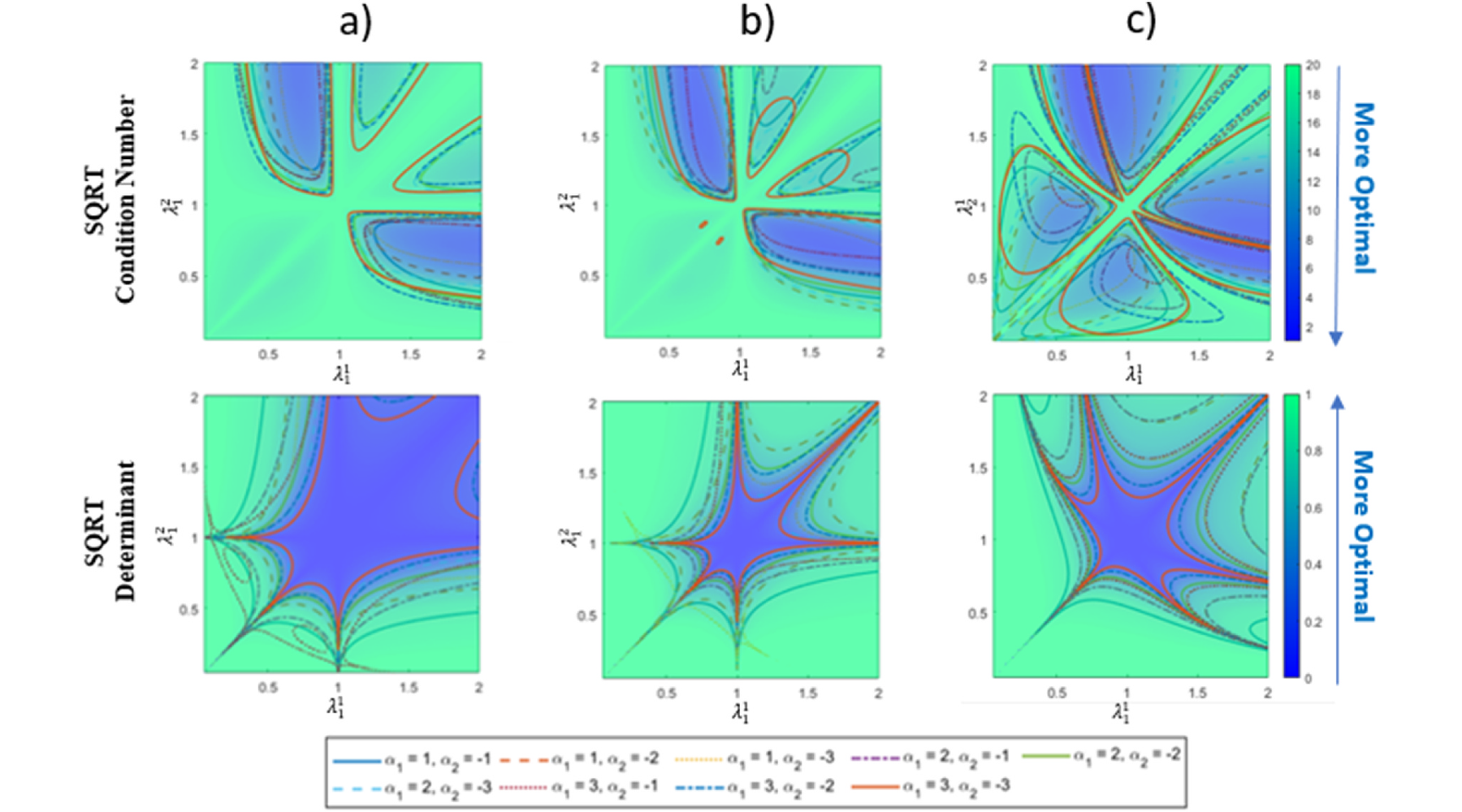
Information and conditioning landscapes used to select robust loading configurations for hyperelastic parameter identification.
Graphical overview of the study workflow and outcome.

Abstract

Reliable identification of hyperelastic material parameters is essential for modeling the mechanical behavior of materials, including biological tissues. Yet experimental configurations often lack quantitative design guidelines, which can produce high variance and poor reproducibility. This work introduces a stress–material Jacobian framework for selecting the loading mode, loading level, and number of experiments used in hyperelastic material characterization.

By analyzing the determinant and condition number of the Jacobian that relates stress space to material-parameter space, the framework identifies experimental configurations that reduce sensitivity to noise, improve robustness, and limit the number of required tests. The approach is demonstrated for Neo-Hookean, Mooney–Rivlin, and Ogden models under multiple loading conditions, and the results show improved parameter-identification reproducibility and robustness to measurement uncertainty.

Hyperelastic parameter identification and optimal loading design

Hyperelastic parameter identification is an inverse problem: measured deformation and stress are used to estimate the coefficients of a constitutive model. The estimated parameters can become unstable when the selected loading states provide redundant information or respond similarly to multiple parameters. This paper treats loading selection as a quantitative experimental-design problem rather than relying on uniformly spaced or operator-selected stretches.

What the stress–material Jacobian measures

The stress–material Jacobian measures how changes in constitutive parameters change the predicted stress response. Its determinant represents local information volume, while its condition number reveals whether parameter sensitivities are nearly collinear. Together, these quantities identify deformation modes and loading levels that are informative, well-conditioned, and less sensitive to measurement noise.

Why this matters for tissue mechanics

Biological soft tissues are often characterized with nonlinear models such as Neo-Hookean, Mooney–Rivlin, and Ogden formulations. Selecting informative tests can reduce the number of measurements while improving repeatability across noise realizations, making constitutive parameter estimates more useful for biomechanics simulations, comparison across studies, and mechanics-based imaging.

Interactive example

How measurement selection changes parameter identifiability

This browser-based version of the accompanying MATLAB example uses a quadratic inverse problem to show the same design principle: informative measurement locations improve conditioning and make parameter estimates less sensitive to noise.

Sampling strategy
Measurement locations
Measurement uncertainty
True model y = 2x² − 3x + 5

Here the design matrix A = [x², x, 1] acts as a simple sensitivity Jacobian.

Least-squares reconstruction True response, noisy data, and estimated fit
Square-root condition number — Lower is better
Square-root determinant — Higher means greater information volume
Parameter error norm — ‖θ̂ − θ‖₂
Design matrix / simple Jacobian A = [x², x, 1]
Estimated parameters θ̂ = [a, b, c]
a
—
b
—
c
—

Key contributions

  • Introduces the stress–material Jacobian as a quantitative measure of experimental information content.
  • Optimizes loading mode, deformation level, and measurement count for hyperelastic parameter identification.
  • Uses determinant and conditioning metrics to distinguish robust configurations from noise-sensitive ones.
  • Demonstrates the framework for Neo-Hookean, Mooney–Rivlin, and Ogden constitutive models.

Method snapshot

InputsCandidate loading modes, stretch levels, and measurement sets
Information objectStress–material Jacobian and its information matrix
Design criteriaDeterminant, condition number, robustness, and reproducibility
OutputAn experimentally efficient and better-conditioned characterization protocol

Research funding

This work was supported by the National Institutes of Health through NIBIB Trailblazer Award R21EB032187 and NINDS Grant 1R01NS131554-01.

Citation

Use the published DOI as the authoritative identifier.

BibTeX
@article{Asadi2025OptimalExperimentalDesign,
  author  = {Asadi, Amirreza and Laksari, Kaveh},
  title   = {Optimal Experimental Design for Repeatable Hyperelastic Material Characterization},
  journal = {Journal of the Mechanical Behavior of Biomedical Materials},
  volume  = {170},
  pages   = {107104},
  year    = {2025},
  doi     = {10.1016/j.jmbbm.2025.107104},
  url     = {https://doi.org/10.1016/j.jmbbm.2025.107104}
}