← Publications / Stress-constrained PI-UNet
Annals of Biomedical Engineering · 2026

Stress-Constrained Physics-Informed UNet for Voxel-Wise Multiparameter Hyperelastic Inversion in Volumetric Medical Imaging

Amirreza Asadi · Kaveh Laksari

Annals of Biomedical Engineering (2026). Published article DOI: 10.1007/s10439-026-04321-4.

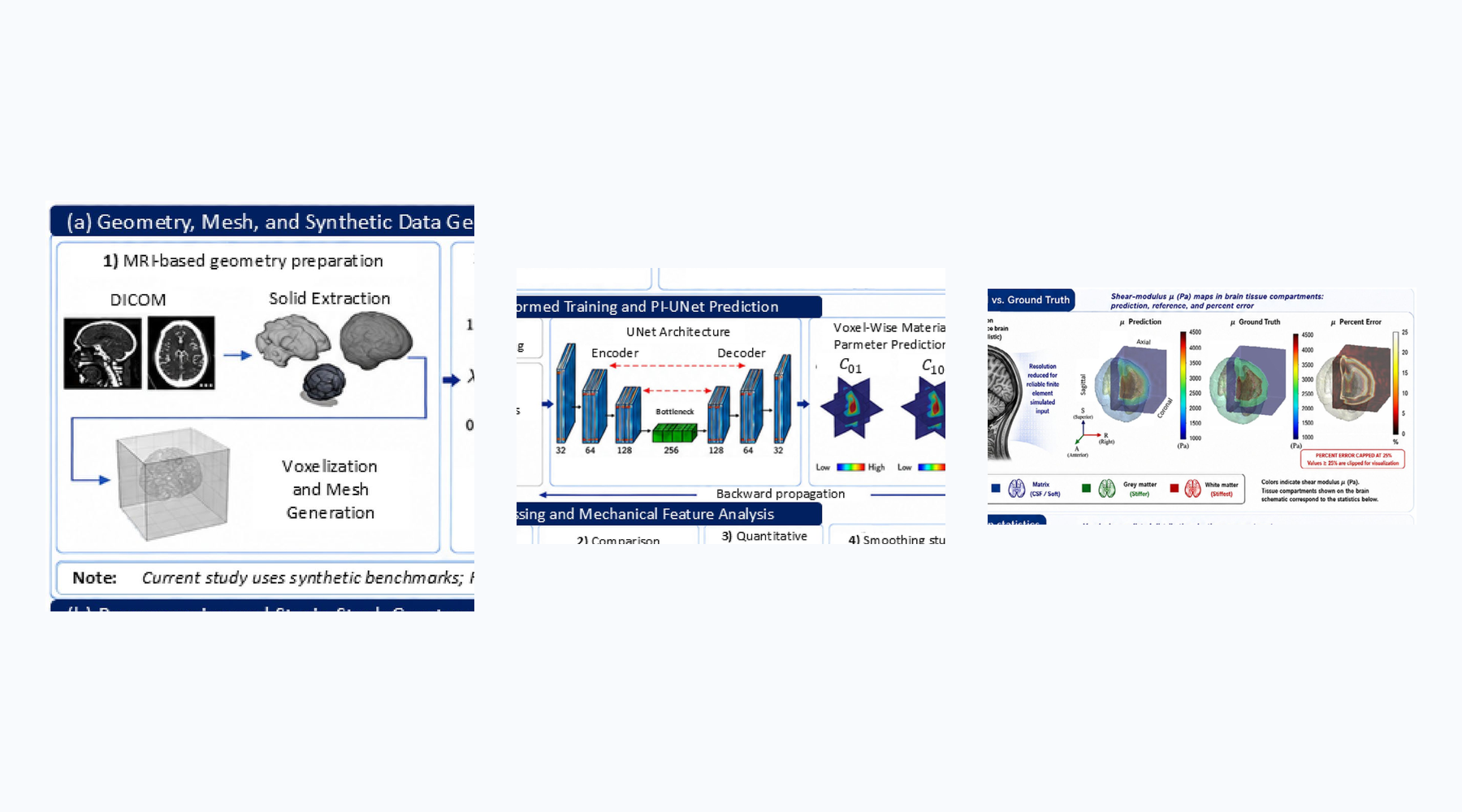
Physics-informed voxel-wise hyperelastic inversion pipeline Volumetric deformation information is processed by a physics-informed UNet to reconstruct spatial maps of nonlinear material parameters. Volumetric deformation Stress-constrained PI-UNet ∇·P = 0 · boundary traction Voxel-wise parameter maps C₁₀ · C₀₁

Abstract

Purpose. To develop a physics-informed computational framework for voxel-wise, multiparameter hyperelastic characterization of heterogeneous soft tissues from volumetric displacement data, with the goal of improving spatially resolved biomechanical imaging and enabling mechanically informed detection of pathological regions.

Methods. A physics-informed UNet estimates spatial distributions of Mooney–Rivlin material parameters from strain-derived volumetric inputs. The framework uses finite-element datasets representing a spherical inclusion, an anatomically realistic gray/white-matter brain, and a brain with a tumor-like inclusion. Its physics-informed loss enforces mechanical equilibrium through the divergence of the first Piola–Kirchhoff stress and incorporates boundary-traction constraints.

Results. The PI-UNet reconstructs heterogeneous material fields across the benchmark configurations, captures stiffness contrasts and anatomical structure, and remains robust under displacement noise when moderate smoothing is applied. In the tumor model, clustering of the reconstructed mechanical fields localizes the lesion with high spatial agreement to the ground truth.

Conclusion. The framework provides a scalable and physically grounded approach for three-dimensional voxel-wise hyperelastic inversion from imaging-derived data and establishes a foundation for spatially resolved tissue characterization and mechanically informed lesion detection.
Key contributions

  • Reconstructs spatial maps of multiple Mooney–Rivlin parameters rather than a single scalar stiffness field.
  • Enforces equilibrium through the divergence of first Piola–Kirchhoff stress and incorporates boundary tractions.
  • Operates on three-dimensional strain-derived volumetric inputs using a UNet architecture.
  • Connects information-aware loading design with physics-constrained nonlinear inverse imaging.

Method snapshot

InputsVolumetric strain-derived channels and boundary reaction information
NetworkThree-dimensional physics-informed UNet
OutputsVoxel-wise Mooney–Rivlin parameter maps
Physics constraintsMechanical equilibrium and boundary-traction consistency

Citation

Use the published DOI as the authoritative identifier.

BibTeX
@article{Asadi2026StressConstrainedPIUNet,
  author  = {Asadi, Amirreza and Laksari, Kaveh},
  title   = {Stress-Constrained Physics-Informed UNet for Voxel-Wise Multiparameter Hyperelastic Inversion in Volumetric Medical Imaging},
  journal = {Annals of Biomedical Engineering},
  year    = {2026},
  doi     = {10.1007/s10439-026-04321-4},
  url     = {https://doi.org/10.1007/s10439-026-04321-4}
}